
‘Keep The Ship Afloat’: Nebraska Chief Justice Funke Reflects On First Year In Top Judicial Role
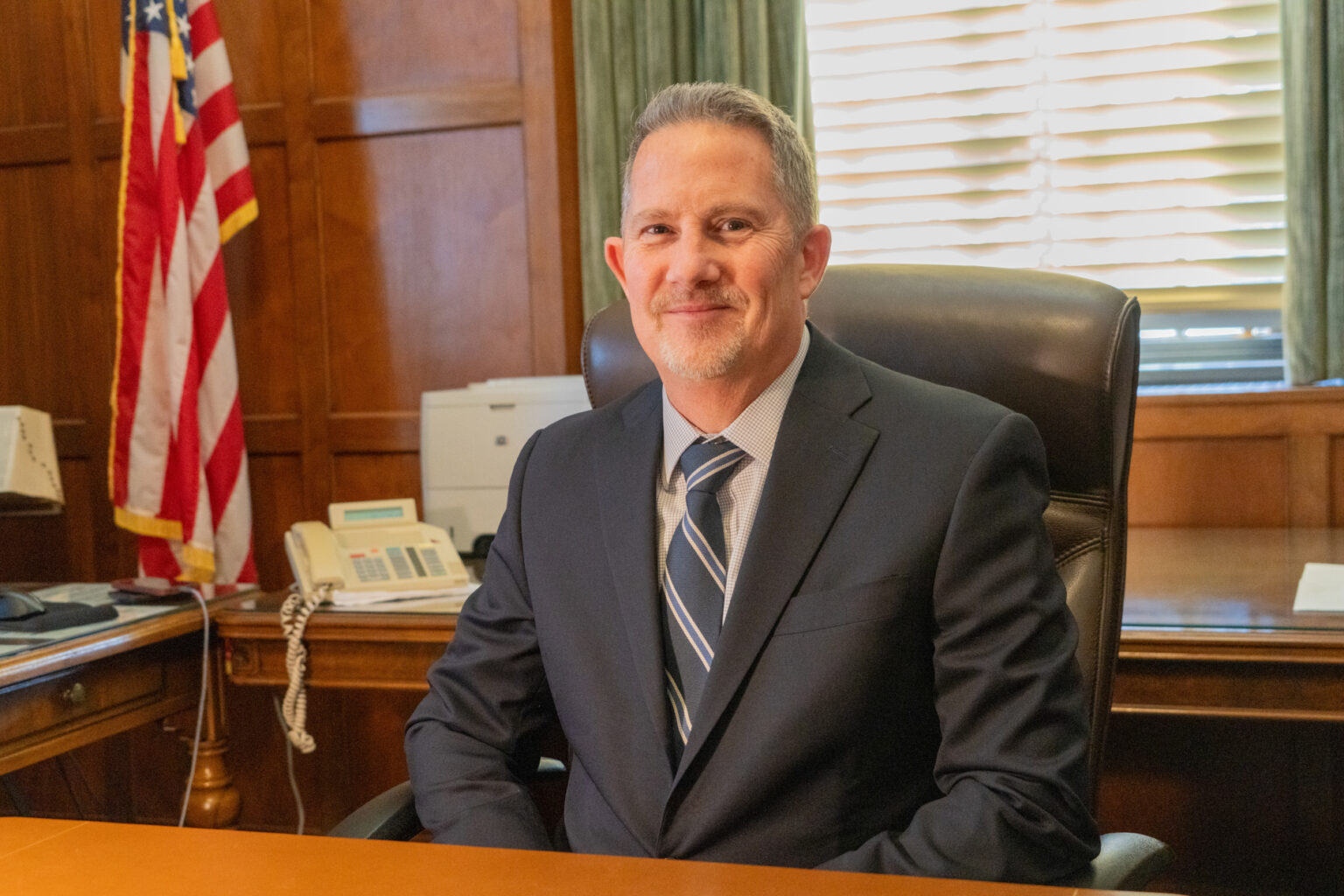
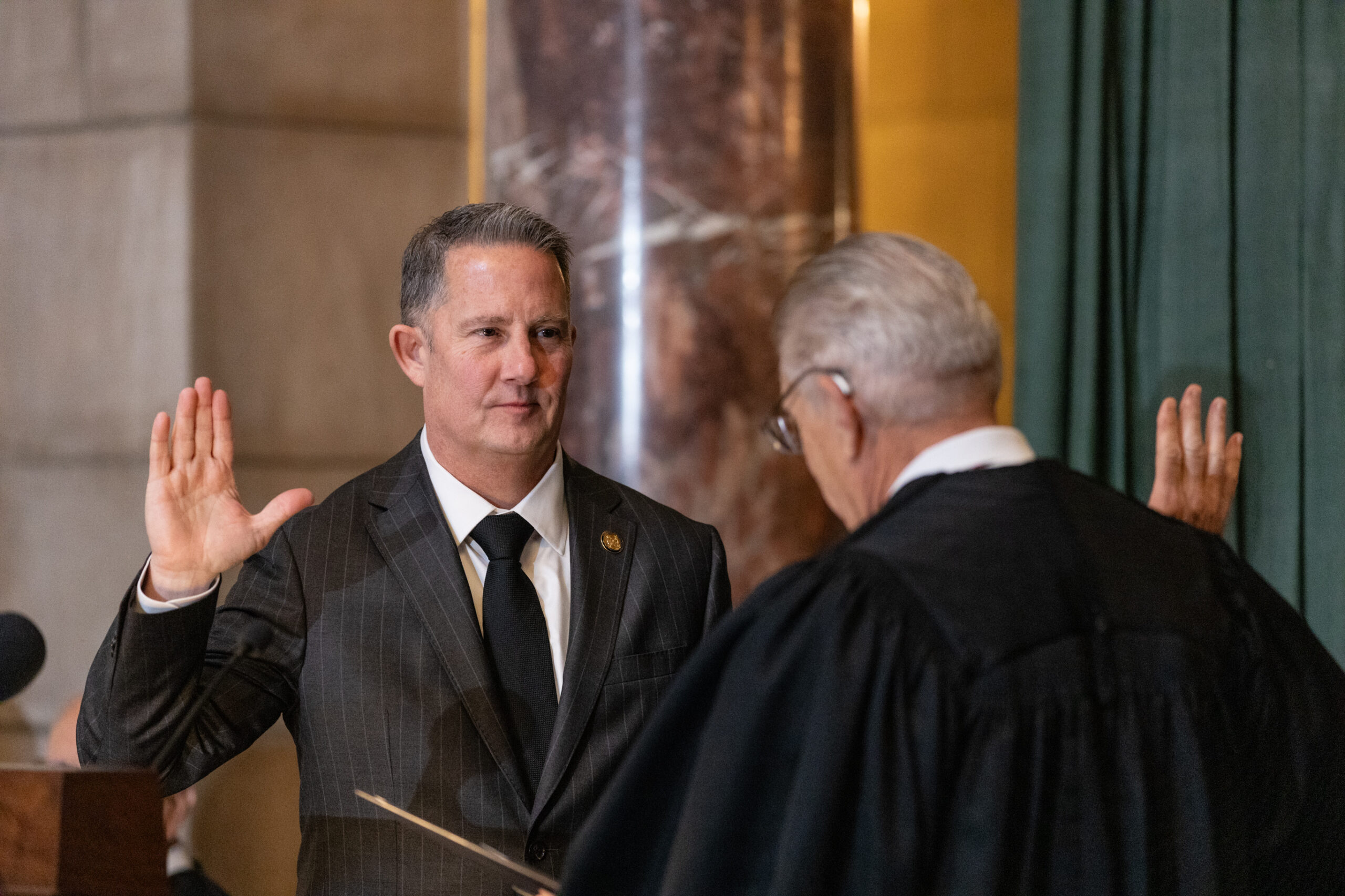
LINCOLN — Nebraska Supreme Court Chief Justice Jeffrey Funke says his first year leading the judicial system was a “learning curve” of trying to “keep the ship afloat” and move forward.
Funke, in a broad interview with the Nebraska Examiner a few days after his November anniversary as chief justice, said he better understands what the Supreme Court does as the administrative body for the judicial branch. He saw closely what former Chief Justice Mike Heavican did daily for nearly 20 years.
“My job was to kind of keep the ship afloat and keep it moving forward,” Funke said.
Now, a year after succeeding Heavican, Funke said he didn’t fully appreciate everything Heavican did.
“He was a self-driven individual that just really was dedicated to the job,” Funke said of Heavican. “I wouldn’t even say 50 or 60 hours a week. It was 70 or 80 hours a week. He was 24/7 doing something as chief justice, and he did it for 18 years.”
Passing The Torch
A first-generation lawyer in his family, Funke said he hoped he was ready to be chief, a step up from his early dreams of one day becoming just a county judge, a milestone he achieved in 2007. He later became a district judge in 2013 and an associate Supreme Court judge in 2016.
Funke said Heavican set a “high bar” for the Supreme Court, and many of its initiatives over Heavican’s tenure came from his ideas and focus. For example, taking Supreme Court oral arguments to high schools, allowing media to bring cameras to trial courts, expanding juvenile probation, creating the Office of Public Guardian and leading statewide summer tours.
“For a long time, I think people just thought it was seven people in the Capitol making these decisions in secret,” Funke said of the Supreme Court. “Really, what we do is we get input from lots of different people, and then we make those informed decisions.”
According to Funke, Heavican, who Funke said often described the courts as the “forgotten branch of government,” saw ways to embrace what the judicial branch did. Funke said Heavican wanted the public to understand the importance of the courts and the impact on their lives.
The Judicial Branch Budget
Funke’s first six months as chief justice coincided with the 2025 legislative session, where state lawmakers and Gov. Jim Pillen, who had promoted Funke in October 2024, had to contend with a structurally imbalanced state budget and a major projected budget deficit.
Funke’s first four to five months in the chief position were about promoting the “good work” of the judicial branch while educating people about the branch’s budget, about $250 million annually and about 1,700 employees.
The core function of the judicial branch is to operate district and county courts in all 93 of Nebraska’s counties, Funke said, plus separate juvenile courts in the three largest counties and the appellate-level Court of Appeals and Supreme Court.
There are also a few dozen problem-solving courts where judges, prosecutors, defense attorneys, law enforcement, community members and more work with high-risk, high-need individuals for individualized, alternative outcomes. These intensive programs aim to support individuals and reduce the likelihood of them reoffending, while also seeking to save taxpayers’ money.
Problem-solving courts include veterans treatment courts, adult and juvenile drug courts, reentry courts, mental health courts and family treatment courts.
Funke said the bulk of a judge’s work is ensuring cases are heard in a timely fashion and that they have the resources they need to do so. The court system also seeks to help people feel comfortable with a judge’s processes, how they make their decisions and why.
“Not everybody’s going to agree with it, but at least they may better understand we did listen to the evidence. We heard all sides. We were fair. We were impartial,” Funke said. “And we based our decision on the facts of the case and the law as the Legislature has adopted it.”
There are about 150 judges statewide who annually deal with close to 335,000 cases each year, Funke said. Of those, about 300,000 are in county courts, another 34,000 are in district courts and about 1,000 are considered by the Court of Appeals or Supreme Court.
The judicial system also runs probation, with about 15,000 to 16,000 adults in the system on any given day, Funke said. There are nearly 3,000 more juveniles on probation daily. Probation consists of a “huge” portion of the court system’s budget and employee count.
About 850 adult convicted felons are in problem-solving courts working to try to rehabilitate their lives to have convictions set aside. There are another 1,300 people on post-release supervision and 400 people through the Office of Public Guardian who need someone to help decide housing, medical care or financial decisions because they can’t care for themselves.
The court also assists individuals with behavioral health, drug and alcohol treatment, transitional housing, education, job placement, domestic violence prevention training and more.
“We’re doing a lot of different things in probation to try to avoid people having to go to prison so that we don’t have an incarceration state and we don’t spend even more taxpayer monies on these types of criminal activities,” Funke said.
The court’s budget is relatively small in the total state budget, Funke said — about $5.5 billion from the state’s general fund, primarily from income or sales taxes each year — but “we take that part of it very seriously.”
Attempted Budget Veto
In May, Pillen tried to veto nearly $12 million from the Supreme Court budget, criticizing the courts for spending more in recent years. However, Funke and other court staff have said those increases have come because lawmakers passed bills to create and fund new initiatives, or told the courts to add programming with existing resources.
Even still, some widely supported legislative programs, such as a nationwide model justice program for all veterans, remain delayed and legislatively unfunded.
Court staff had said the vetoes would close some problem-solving courts and other services. Some lawmakers had begun preparing to defend the programs from Pillen’s judicial vetoes. The cuts to the courts would have been more severe without a last-ditch effort to restore $3 million in one of the final rounds of budget debate.
“Every branch of government must contribute to balancing our state budget,” Pillen said in his May 21 veto message.
The Legislature said the Pillen vetoes weren’t properly submitted according to the Nebraska Constitution, and the governor ultimately backed down after consulting with Speaker of the Legislature John Arch. Had Pillen fought the Legislature, it could have been the Supreme Court deciding a constitutional challenge. Pillen later accepted responsibility for the veto “mistake.”
But budget adjustments are likely back on the menu for 2026, Pillen and Arch have said. Pillen has suggested he might seek to revive the vetoes. All this came before Nebraska’s budget situation worsened, largely from revised economic forecasts. Lawmakers face another nearly $500 million budget hole to fill.
Doing More With Less
Funke said the current state budget allowed the courts to continue all programs and services. However, he said the judicial branch, similar to all other areas of government, has an obligation to be a good steward of tax dollars. That includes a “deep dive” into court finances and efficiencies, an endeavor that has been ongoing for the past six months.
“We have to make sure that we continue that high level of output but do it with less money,” Funke said.
This could mean utilizing technology to find efficiencies or having judges travel less between courts in their judicial district, such as more remote hearings. It could also mean more problem-solving work to try to save money elsewhere.
“But at some point, we’ll have to decide: What services do we get the most bang for the buck?” Funke said, adding that “realistically,” some services will need to end in 2026.
In the end, Funke stressed the judicial branch is a separate and equal branch of government.
“They may control the purse strings and how much budgetary monies we get,” Funke said of the executive and legislative branches. “But we are a separate branch, and we have to make the decisions based on what we think is best for the citizens of the state.”
Funke added: “I think we’re doing that, and I’m proud to put us up against other judiciaries across the country.”
‘Real People’
Funke has sought to continue Heavican’s work of openness and transparency for the courts. He was a trial judge when Heavican looked to bring cameras into trial courts, which expanded statewide by 2017. Funke said it has been effective and was an early supporter of the initiative. The courts now livestream public interviews for judicial applicants, too.
Funke also praised the continued work of going to high schools for oral arguments, of which many high schoolers would likely never hear. Supreme Court judges spend 20 to 30 minutes after answering student questions.
This could include federal issues, trust and confidence in the courts or social issues, some of which judges can respond and others they can’t. The Court of Appeals also goes to high schools, and both have taken oral arguments to law colleges, too.
In early November, the Supreme Court hosted oral arguments at Connestoga High School, which Funke said is about 25 miles from where he grew up in Nebraska City. He said it was nice to be in his neighborhood and that students hopefully saw he’s “just like them, just a lot older now.”
“We’re not some abstract figure,” Funke said, adding it helps judges be seen as “real people.”
As a trial judge, Funke said he spent lots of time coaching youth sports, including football and basketball. His wife coached volleyball. Funke was also heavily involved in high school sports, serving as the public address announcer for football for 25 years at the high school his children attended.
“As much as a judge can be involved in the community, I got involved in the community, and I enjoyed it,” Funke said, adding he was not alone among judges.
He emphasized that the courts are only as effective as the public has trust and confidence in the courts, so he takes it upon himself to advocate for his branch. He said he has not turned down any interviews or speaking opportunities since becoming chief.
Vacancies And Public Scrutiny
Funke said this is also important as the courts face a decline in applicants for judicial vacancies.
Just two applicants recently applied for the Omaha-based vacancy on the Supreme Court for now-former Justice Lindsey Miller-Lerman, who was appointed to the high court in 1998. Her successor, Justice-designate Derek Vaughn, a district judge, highlighted a similar challenge he hopes the Supreme Court can continue to address when Pillen appointed him last month.
If there are not at least two applicants forwarded to the governor to pick from, the process restarts. That happened recently during the search for replacement judges in Madison and Dawson Counties.
“I think now is an opportunity where we have to really kind of double down and redouble our efforts to make sure that we are doing all that we can do to explain the work of the judicial branch, demystify the process of becoming a judge,” Funke said.
Funke said part of this means uplifting that judges have personal lives, are public servants and are often hand-picked from their communities. For some prospective judges, donning the black robe could mean giving up a more “lucrative” legal practice where they could make more money, Funke said.
Supreme Court justices have a salary of $228,431.18. All other state judges are paid a percentage of that — 95% for Court of Appeals judges; 92.5% for district judges, separate juvenile court judges and Workers’ Compensation Court judges; and 90% for county judges.
Funke said there is also public scrutiny to consider. He said judges decide on the law and the constitution, “not based on what they think the law should be, what their own personal belief is or anything of that nature.”
Being from a small community, Funke said it could be difficult to make decisions where people knew him or his family. But he, like others, must set that aside. In recent years, Funke said scrutiny has intensified, which could be part of the reason for less interest in judicial positions.
Path To Chief Justice
Funke recalled suggesting to his parents that he wanted to go to law school when he was younger, and “we all had to figure out what that meant and how that would work.” One of his mentors was a neighbor, the county attorney for Otoe County, who later became a judge.
Funke would go on to the University of Nebraska-Lincoln for an accounting degree before going straight to the University of Nebraska College of Law in 1991. In his third year of law school, Funke took a position back home as a deputy public defender for the county, a position he held for three years.
The following decade, Funke worked in the Otoe County Attorney’s Office and became a deputy county attorney for eight years. When the county attorney became a judge, county commissioners appointed Funke to the vacancy, and he was elected to the position.
He also worked in private practice for 13 years after law school.
In 2007, a judicial spot opened on the Sarpy County court bench. Funke was one of a dozen applicants. Then-Gov. Dave Heineman appointed him in the southeast Nebraska district in 2007, which gave Funke experience in rural Otoe County, Cass County and a more metropolitan area of suburban Sarpy County, which he said was a “really good learning experience.”
In 2013, a district court spot for Otoe and Cass Counties opened, which happened to be the former post of Funke’s mentor. Funke applied, and Heineman elevated him.
Funke described the trial courts as “a place where you got your hands really involved in the process,” such as hearing from litigants, seeing witnesses, weighing the credibility of testifiers and evidence and ultimately making decisions.
Come 2016, with the retirement of Supreme Court Justice William Connolly, then-Gov. Pete Ricketts elevated Funke again. Funke thought to himself, “Those spots don’t come open very often.”
“If you want to give yourself a chance to be on the Supreme Court, you got to take them when you can get them,” Funke said.
Of all current members of the Supreme Court, all but one previously served as a trial judge.
‘Pride In The Work We Do’
The Supreme Court has heightened Funke’s focus not just on the law but on process and procedure, largely because appellate cases are dictated by jurisdiction and whether cases are done “correctly” before reaching the highest state court.
Funke attributed any success in the judicial branch to its public servants, including staff who have stayed for decades, as well as judges who make hard decisions most Nebraskans will never see or be reported on and won’t ever reach the Supreme Court.
“We take pride in the work we do. We understand how important it is to the citizens of the state, and people strive to do the best they can,” Funke said. “We’re fortunate that we have those people working for us.”
This story was published by Nebraska Examiner, an editorially independent newsroom providing a hard-hitting, daily flow of news. Read the original article: https://nebraskaexaminer.com/2025/12/02/keep-the-ship-afloat-nebraska-ch...
Category:
User login




Omaha Daily Record
The Daily Record
222 South 72nd Street, Suite 302
Omaha, Nebraska
68114
United States
Tele (402) 345-1303
Fax (402) 345-2351
222 South 72nd Street, Suite 302 | Omaha, Nebraska 68114 | United States | Tele (402) 345-1303 | Fax (402) 345-2351 | Sitemap
