
War And Young Men
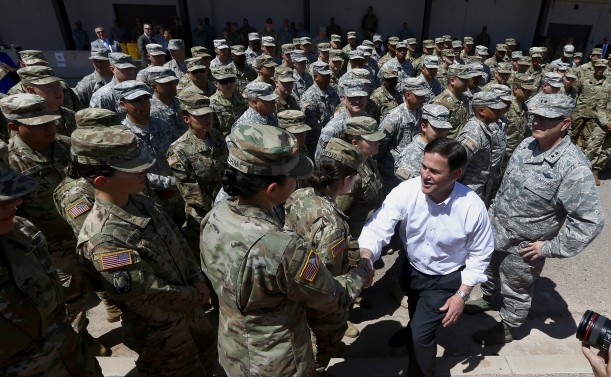
Arizona's Republican Gov. Doug Ducey (front right) meets with Arizona National Guard soldiers prior to their deployment to the Mexico border at the Papago Park Military Reservation on Monday, April 9, 2018, in Phoenix. (Ross D. Franklin / AP Photo)
There is one earthly resource that has a greater luster than gold, a higher energy output than coal, and has more military applications than the highest technology. It is a simple word, a thing taken for granted by all but the wisest: ‘manpower’.
Manpower is a military term for generally, “the amount of men readily available to be put into combat, support, and logistical roles.” An economist might use the term “workforce" analogously. Still, the number of people available for labor would fall under the umbrella of support and logistical roles, because a whole economy determines the wealth that is available for a nation to fight its wars, as well as the quality of care for returning and rotating soldiers from the warfront.
Thus, the argument is this: manpower still dictates wars, and has since the beginning of humankind. Sure, there are great generals and conquerors throughout history who have done a whole lot with relatively fewer men, but if it were standard for the underdog to win, the underdog wouldn’t be what it is. Those few generals against the standard did the impossible with little. And to expound: again in World War 2, the Nazi’s had particularly lethal weapons, planes (even rocket fighters), Tiger tanks, etc. However, the Russians simply had more bodies to throw at the problem than bullets which the Nazi’s could shoot.
There are some ‘levelers’ that make manpower less effective. A general rule in attacking fortified positions is to have three times more men than the defender. This is even true of the troop counts in Ukraine, where Russia has a three-to-one advantage over Ukraine and suffers a three-to-one loss. ‘Casualties’ are the rate of loss, not the rate of death. Some men might become severely injured due to combat, some might flee and run away, some might die, and some might get captured. Casualties drain the ‘manpower pool'.
Wars aren't always lost due to a shortage of manpower: look at Vietnam and Korea. The United States had plenty of men to spare; it just got tired of fighting. However, being unable to field enough men (whichever number of bodies is needed) always results in a loss. Running out of young men to absorb bullets (or, historically, arrows) usually means older, and even younger men who keep the nation running at home will be drawn up and sent to fill in the gaps to staunch battlefield losses is usually a double-negative loss.
First: such an economy with a reduced workforce has fewer capable and technical hands than it did before, which results in a slowdown of both current output and future output twice over because those men are not passing their skills to a future generation, and the death of those older and much younger men will result in a smaller future workforce.
A total collapse of manpower is the total collapse of a war, and a total capitulation and likely subjugation by the loser, with an economy that is then going to be generations behind a capitalist world, which always tries to surge ahead towards the future, consequences for the environment and humanity be dammed. In times of peace, population booms and people become cheap and expendable; for example, you could have big machines fueled by coal or oil, mine cobalt in Africa for the newest iPhone, but it is simply cheaper to use humans with pickaxes who live in squalor.
After World War II, U.S. doctrine was based on the idea that we would never be able to field the same amount of troops or tanks as the USSR (Russia), nor be able to reinforce as fast as they, since the majority of our population sat across an ocean. We wouldn’t have been able to respond in time to a massive push by the USSR if they tried. We just didn’t have enough guys flying planes to bomb them fast enough. The overwhelming manpower of the combined nations under the umbrella of the USSR, and the adjacency of its populations, would mean the reinforcement rate of its manpower would be totally overwhelming.
This doctrine said that we would instead focus on more precise bombs, which could be launched from stealthier and faster jets towards exceptionally important and hardened targets, which were critical to any Soviet war effort. That, and we developed the North Atlantic Treaty Organization, ‘NATO’. The organization was built up in partnership with many nations of Europe to combine their armies under a unified command under the United States military, to make ammunition, transportation, intelligence, and communication streamlined. What it also did was combine the manpower of many nations into a single unified ‘pool’; an ocean of young men to be placed as a wall against an opposite ocean of young men.
Weapons, guns, soldiers, etc., all fall under the military term ‘hardpower.’ And while the U.S. certainly has a whole lot of that itself, it has spent all the years since the birth of our nation cultivating what is termed ‘softpower’. Such is a term which describes the ability to move things politically without the need for hardpower – without the need for old men to breach a nation’s own manpower pool and all the consequences which come with it. Alliances are softpower with the threat of more hardpower behind it, but then there is also the morale and gratitude of a nation’s populace.
By praising allies, and especially crowning them with honors for past deeds, the population of one nation is more likely to feel a sort of kinship towards the other, as it was with France and America in her early years, when she supported American independence, and, later, when we Americans came to her defense in World War II.
What is a soldier worth to a war effort if he refuses to fight? What is the real depth of a manpower pool if none of the young men in it believe in the cause?
Recently, in the U.S., it seems there has been much in the way of ignoring, badmouthing, or even applying tariffs to those who were, but a year before, much more likely to rally around an American banner.
This essay may be bleak and deprived of moral arguments, but it is a logical layout of rationale. I wish for no young man to be the bullet sponge for old, grudge-filled politicians and industrialists, but war has always been a staple of humanity, and such young men have died the same way in the hundreds of millions. The one in Ukraine has shown us that the need for manpower is not going anywhere soon.
Austin Petak is an aspiring novelist and freelance journalist who loves seeking stories and the quiet passions of the soul. If you are interested in reaching out to him to cover a story, you may find him at austinpetak@gmail.com.
Opinions expressed by columnists in The Daily Record are not necessarily those of its management or staff, and do not constitute an endorsement or recommendation. Any errors or omissions should be called to our attention so that they may be corrected. Contact us at news@omahadailyrecord.com.
Category:
User login




Omaha Daily Record
The Daily Record
222 South 72nd Street, Suite 302
Omaha, Nebraska
68114
United States
Tele (402) 345-1303
Fax (402) 345-2351
222 South 72nd Street, Suite 302 | Omaha, Nebraska 68114 | United States | Tele (402) 345-1303 | Fax (402) 345-2351 | Sitemap
