
Paused Democracy
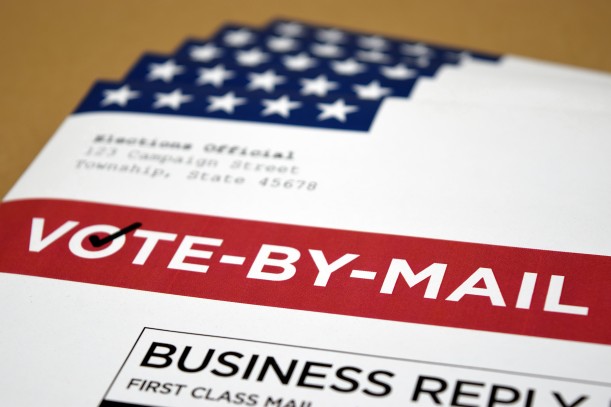
(Castleski / Shutterstock)
Back when the world was a simpler and more savage place, when the stars in the night sky were not counted in the tens or hundreds, but in made-up numbers more akin to the holes in an old blanket, used to roof a child’s fort – back when American frontiersmen sought to distance themselves from busy coastal cities and with arms of granite they would hewn down prehistoric trees to make one room cabins for their families– there was a need in the Thirteen Colonies for men to be able to vote from their homesteads. The earliest examples are from Massachusetts in/or around the 1700’s, as noted by Alex Keyssar’s book, “The Right to Vote", for homes "vulnerable to Indian attack.”
And, if the weather was dangerous or a fellow was sick, in New England, among other places, a man could have another vote for him in a town hall. When it came time to shake free of the tyranny of those men and women in Europe who would be so without humility to call themselves “nobles," in the spring of 1775 during the opening months of the American revolution – New Hampshire was the first Colony to allow men in towns to be able to carry the vote for their fellow who was off fighting the British and their Hessian mercenaries in winters which were unduly cruel to American soldiers.
The ability for men to vote in the experiment called democracy was so important to the Thirteen Colonies, that for some of the men serving in the Continental Army, their vote was brought in letters, "as if the men were present themselves.” However, voting away from central town-hall type locations was not exceptionally widespread, at least until The American Civil War, in 1884, in which Union soldiers, and even men who fought for the Union but were born in – and until that war – had recently lived in the Confederacy were allowed to vote under the supervision of clerks and/or state officials in what were likely large gathering places, or field hospital type tents.
Over the following decades, mail-in voting became very prominent, and even protected for servicemen and women who were stationed overseas and around the world, so that the voices of our soldiers mattered. Absentee voting is by far the most common way that our warriors vote. And, of course, what if you were on a long business trip overseas? Should a person lose their voice in democracy because of their pursuit of property? Of capitalism? Of course not.
Then came protections for the disabled who, like the original colonists of New England, might have been too sick to leave their houses and were thus allowed to vote. Democracy is only democracy if everyone who is a citizen gets to vote. Pointedly and recently, the current administration of the United States has forbidden the U.S. Postal Service from delivering mail-in ballots from any state that has not disclosed its full voter registry to the Trump Administration. So, before an election, this president or whoever the next one is can just refuse votes in the normal and traditionally accepted way because they are from States which are opposed to him? Like the frontier of the rancor-Great-Plains, such an act it is… absolutely wild.
The Constitution of the United States of America says about voting:
“The Times, Places and Manner of holding Elections for Senators and Representatives, shall be prescribed in each State by the Legislature thereof.”
(And that the rules of elections in each state could be changed by an act of Congress, if they so deemed to amend the Constitution through legislation). For Presidential elections, the Constitution is broader, dictating thus:
“Each State shall appoint, in such Manner as the Legislature thereof may direct, a Number of Electors..." and: "The Congress may determine the Time of choosing the Electors, and the Day on which they shall give their Votes..."
Nowhere does it say that the President, or the executive branch, may deny accepting ballots from the states which collect them, especially for ballots regarding votes for Senators and Representatives, whose powers are explicitly given to state legislatures.
There are those who decry widespread election interference via mail-in voting, but they don’t have any sort of raw data beyond President Trump saying, "Millions of illegal votes were cast for Democrats, trust me, bro.” The rawest and largest data set compiled on illegal ballots was done by the most comprehensive study on voting ever. Called the Voting Rights Project, or "Who Can Vote?” of 2012.
Produced by twenty-four students under the direction of journalism professionals, funded in part by the Ethics and Excellence in Journalism Foundation and the Hearst Foundations, as per the Voting Rights Project’s website,
“The Fellows traveled to more than forty cities, twenty-one states and one U.S. Territory, conducted more than 1,000 interviews, requested thousands of public records and revised nearly five thousand documents. Their most ambitious effort was to gather, organize, and analyze all reported cases of election fraud in the U.S. since (the year) 2000.”
This data found that even with calls for tougher voting laws, which got thirty-seven state legislatures to either ponder or enforce tougher voter-ID laws, revealed only ten such cases (of in-person voter impersonation) over the entire course of a decade.
They did find far more fraud in absentee ballots than in any other category. Would any reader like to guess the number? It is far, far higher than ten. So high, actually, that it might affect an election– Ha, just kidding! The fellows did discover 491 cases of absentee ballot fraud throughout the whole United States and all of its territories, which, to a layman, could be considered a whole lot. That is, of course, if it were a single election in a small town. Breaking that down per year means (I’m bad at math) about 49.1 fake votes per year. In each case, the Voting Rights Project discovered that a required photo ID at any physical location would not have prevented the also 400 cases of voter fraud (spanning a decade).
Because I love arguments: playing the devil's advocate, one might counter argue that those cases of ballot fraud were only the cases discovered – that is absolutely true. But for it to happen on a scale that matters (the United States counts almost 100 million votes each election cycle), then it would be far easier to ascertain, and happen with far more regularity that there would be ample evidence beyond President Trump’s claim, “That it happens a ton, bro."
The Republicans in 2020 led a special investigations committee which determined that there was no systematic or vast election fraud, to any amount which could have affected the 2020 election. Similarly, multiple counts and recounts of the Georgia election ballots found that there was no fraud. If the president had concrete evidence –nay, even circumstantial evidence like is mentioned in the Epstein Files– he could likely do what he wanted about it, and people would support his actions in bringing about truer and more fair elections.
There are, however, documents and missives from the Department of Homeland Security, which they wrote, “We assess that Russia is likely to continue amplifying criticisms of vote-by-mail and shifting voting processes…to undermine public trust in the electoral process.”
Ensuring that every U.S. citizen has the ability to participate in the rights guaranteed to us by the Constitution, to decide who will govern us, is paramount; whose origin is so American that it predates even the Constitution itself in pre-revolutionary America.
Russia, however, wants you to believe that mail-in voting is bad. Why is that? Does, uh, the Kremlin care about Americans..?
Austin Petak is an aspiring novelist and freelance journalist who loves seeking stories and the quiet passions of the soul. If you are interested in reaching out to him to cover a story, you may find him at austinpetak@gmail.com.
Opinions expressed by columnists in The Daily Record are not necessarily those of its management or staff, and do not constitute an endorsement or recommendation. Any errors or omissions should be called to our attention so that they may be corrected. Contact us at news@omahadailyrecord.com.
Category:
User login




Omaha Daily Record
The Daily Record
222 South 72nd Street, Suite 302
Omaha, Nebraska
68114
United States
Tele (402) 345-1303
Fax (402) 345-2351
222 South 72nd Street, Suite 302 | Omaha, Nebraska 68114 | United States | Tele (402) 345-1303 | Fax (402) 345-2351 | Sitemap
