
AltEn Disaster: Initial Scientific Report Shows Johnson Creek Lake Likely “Biologically Dead,” Saunders County Residents Have Reason For Health Concerns
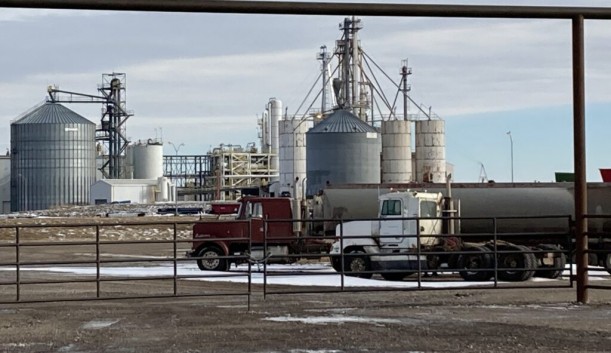
The AltEn Ethanol plant south of Mead, Nebraska, is now closed. It is subject to a clean-up order from state environmental regulators. (Paul Hammel / Nebraska Examiner)
An investigative team comprised of scientists from the University of Nebraska Medical Center (UNMC), University of Nebraska-Lincoln (UN-L), and Creighton University unveiled its initial findings about the AltEn ethanol plant disaster when members presented their report on Thursday, June 16 at a town hall meeting at the Mead, Nebraska Fire Hall. The team was formed following a four million gallon spill at the plant site in February 2021, which washed downstream. Initial funding for the research and investigative effort was provided by a private donor that was later supplemented with a $1 million allocation by the Nebraska Legislature at the request of State Senator Carol Blood after lawmakers failed earlier in the 2022 session to fully fund the team’s work.
The AltEn plant made national and international news for utilizing pesticide-coated seed - mostly corn - in its ethanol production practices, a process approved by state regulators at Nebraska Department of Energy and Environment (NDEE) nearly a decade ago when the plant was under construction. NDEE approved the use of treated seed without a public comment process. Sixteen months ago, AltEn was shut down after repeated letters of violation issued by NDEE over the years - that went largely unenforced - culminated in the plant ignoring orders by regulators to clean up massive piles of pesticide-ridden wet cake stockpiled at the site.
During last week’s town hall, Dr. Ali Khan, Dean of the UNMC College of Public Health and member of the scientific team, said based on the preliminary findings residents have good reason to be concerned about adverse health and environmental impacts from the massive environmental catastrophe. Test results show the toxic pesticides found in high concentrations at the AltEn site are also being found in high concentrations in surface and groundwater, soil, bee colonies, plant tissue miles from the plant site, and inside a private home northwest of the plant where one compound - imidacloprid, a fungicide - was measured at 407 parts-per billion in common household dust.
In addition, thirteen of the 21 compounds involved at the AltEn site have been found at Johnson Creek Reservoir, a 56-acre pond that serves as a flood control mechanism for the Crystal Creek watershed. The watershed and reservoir are managed by the Natural Resources District (NRD). A private six-acre pond located six miles downstream from the AltEn plant was declared “dead water” last year, so severely polluted with pesticides it is unable to sustain life.
Documents posted on the NDEE website show the same pesticides are now being found in an aquifer that lies 30 to 50 feet below the soil surface at AltEn. An analysis of ground and surface water downstream from AltEn shows the same list of pesticides as well as a new worry: “degradation compounds,” substances that occur when the parent compound transforms in the environment.
“These initial findings are a bombshell that certainly underscore the need for further scientific examination of the breadth and scope of this catastrophe,” said Al Davis, spokesman for the Perivallon Group, an informal group of volunteers that meets weekly on the AltEn disaster. “We are thankful for this unprecedented team of scientists working to do so. The fact that these chemicals have been discovered inside the residence of a private home means they are probably in more homes and structures in Saunders County. Further testing needs to be conducted at schools, churches, and private residences. Additionally, we now know that some of the highest pesticide concentrations have been found in Johnson Creek Reservoir, 4.5 miles from AltEn, likely rendering it biologically dead.”
“The $1 million allocation by the legislature for the UNMC/UN-L/Creighton team will extend the work only until next year. It is imperative that the legislature act to fully fund the effort, which the team anticipates will be $8 million for 10 years. Included is a non-identifier medical registry offered to Saunders County residents to begin tracking human medical issues. We strongly encourage residents of the AltEn area to permit sampling of their homes or farmland so as much data can be collected as possible. This catastrophe is going to require strong, decisive, transparent leadership from lawmakers and cooperation from citizens in order to understand how it can be cleaned up and how much the cleanup will cost. The health of Nebraskans as well as our water and air quality are on the line. There is absolutely no time to waste.”
User login




Omaha Daily Record
The Daily Record
222 South 72nd Street, Suite 302
Omaha, Nebraska
68114
United States
Tele (402) 345-1303
Fax (402) 345-2351
222 South 72nd Street, Suite 302 | Omaha, Nebraska 68114 | United States | Tele (402) 345-1303 | Fax (402) 345-2351 | Sitemap
