
Bad, Blue Water
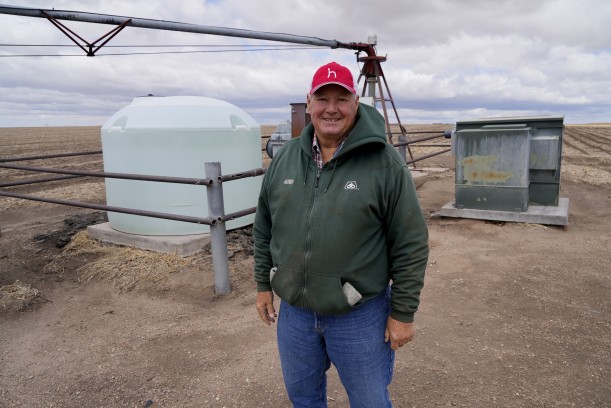
Steve Hanson poses for a photo in front of one of his water pumping stations Saturday, April 30, 2022, in Elsie, Neb. He raises beef cattle and grows corn, all of his irrigation water coming from the Ogallala Aquifer. (Brittany Peterson / AP Photo)
In Nebraska, we are exceptionally fortunate to sit above the largest underground reservoir of water in all of North America: the Ogallala Aquifer. The body of water sits below us in gravel, silt and other porous sediments, the topmost edges begin in South Dakota (if looking at it from above as if it were a visible lake) and then it travels downward and goes under parts of Wyoming, then Nebraska, Colorado, Kansas, Oklahoma, New Mexico and then Texas for (what was recognized as) a total of “3.2 billion acre-feet” of water. A U.S. Geological Survey publication on pubs.gov says that about 66% of the total water volume of the aquifer is under the State of Nebraska (though on a map, the water table looks spread wide under many states, it is the most concentrated in Nebraska). 66% is about 2.1 billion acre-feet. Another geological survey also published on that government website showed that Nebraska has lost 286.4 million acre-feet of water since 1950 due to industrial farming, industrial plants, and local potable well water.
There are underground water systems in the United States that are not so grand, and in fact are quite terrifying. The Columbia Plateau River System (especially the Lower Umatilla Basin) in Oregon, for example, has been found to have ten times the federal limit of nitrates in the tap water. Since the water is stored in basalt rock, underground flow is more restrictive; thus, toxins and chemicals can become more easily trapped in local areas, as in the Lower Umatilla Basin.
Rolling Stone investigated this issue (which has been known about for years now) and interviewed former Morrow County Commissioner and Republican Jim Doherty. His county sits right above the Lower Umatilla Basin. The region is known for its massive cattle farms, whose nitrate-filled water (manure) is sent to a wastewater center, and then that water is sprayed over crop fields as fertilizer.
Jim wanted to see how bad the problem was, so he randomly tested the water from three homes and found all three to have ten times the legal limit of nitrates. Then, to gauge the scope of the problem, he tested the tap water of seventy homes and found sixty-eight of them were contaminated. He also spoke with the residents, and he was surprised at how many residents had been diagnosed with cancer, as well as a strangely high rate of miscarriages.
The industrial giant, Amazon, has also opened their own data centers near there, and (like many data centers around the world), to cool their servers, they pump tens of thousands of gallons of water through them daily. While that water is most likely not treated with nitrates, it is pumped out to the water-treatment station – the same one that handles all of the contaminated cow water. With 38 years of experience, Greg Pettit, who led Oregon’s Groundwater Quality, says that such an increase in volume pushes water through the system faster, and takes the nitrates over the fields faster and into the soil quicker, which then percolates down to the water table.
“Infant Methemoglobinemia” is an acute and serious hazard for babies, which leads to low oxygen in their blood and trouble breathing. The illness is directly correlated to nitrate intake, since babies’ digestive tracts convert it too easily; thus, the reason for the Federal standard nitrate levels, and the drinking water in the Lower Umatilla Basin is ten times over the Federal limit. There is also research that supports higher rates of rare cancer in adults, especially digestive-related cancers, which correlate with County Commissioner Jim Doherty’s findings.
In Nebraska, even in our much larger Ogallala Aquifer (as per the U.S. Geological Survey), somewhere between 25% to 30% of groundwater wells have above the recommended levels of nitrate levels, and it is rising. If the above data is correct, then areas where the aquifer is thinner, less porous underground, or nearer to farms which use animal manure (especially those which also share the same water as data-centers) are more likely to have harmful levels of nitrates, which, lead to cancer in adults and possible death in infants and babies, if not some sort of long term effects from having oxygen-deprived blood. Infant Methemoglobinemia has also been called “Blue Baby Syndrome.”
Supreme care for our underground water in Nebraska is needed, as it is the water that our children’s brains, and our own, will use to develop and remain healthy. Some sort of fix is needed before more of our aquifer is poisoned to levels near that of Oregon.
Austin Petak is an aspiring novelist and freelance journalist who loves seeking stories and the quiet passions of the soul. If you are interested in reaching out to him to cover a story, you may find him at austinpetak@gmail.com.
Opinions expressed by columnists in The Daily Record are not necessarily those of its management or staff, and do not constitute an endorsement or recommendation. Any errors or omissions should be called to our attention so that they may be corrected. Contact us at news@omahadailyrecord.com.
Category:
User login




Omaha Daily Record
The Daily Record
222 South 72nd Street, Suite 302
Omaha, Nebraska
68114
United States
Tele (402) 345-1303
Fax (402) 345-2351
222 South 72nd Street, Suite 302 | Omaha, Nebraska 68114 | United States | Tele (402) 345-1303 | Fax (402) 345-2351 | Sitemap
