
Nebraska Lawmakers Keep $3.5M For Private School Funding, Vouchers ‘Bridge’ Program For Now
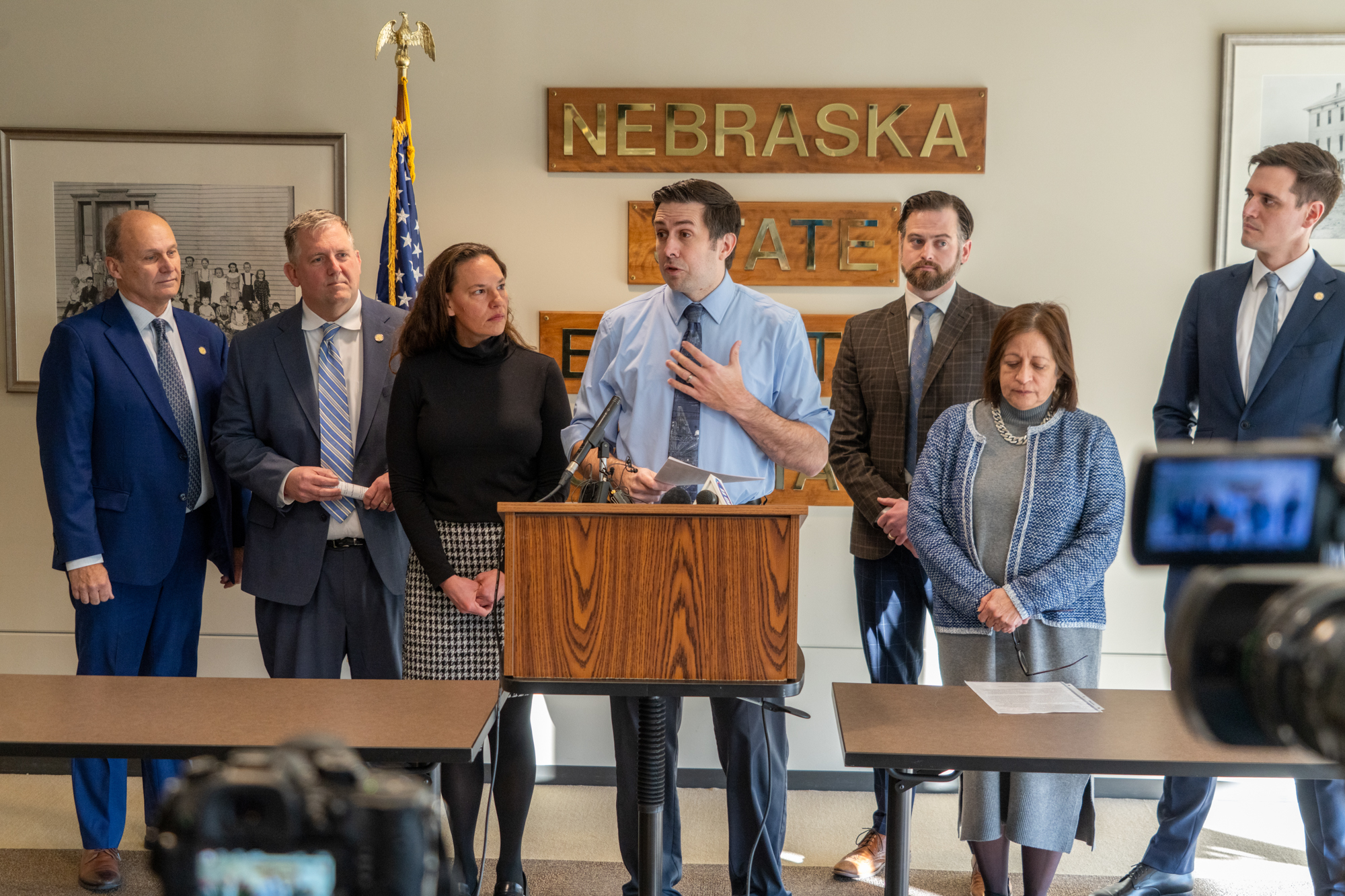

LINCOLN — Lawmakers kept $3.5 million in Nebraska’s state budget Monday to help students using voter-repealed state funding to attend private K-12 schools with one-time “bridge” support until a new federal tax credit comes online.
An amendment to Legislative Bill 1071 to remove the bridge funding and $150,000 in administrative costs failed 23-17. The change, from State Sen. Tom Brandt of Plymouth, needed 25 votes. Brandt said he was “disappointed” in the outcome and said he had 27 senators at one time, but a few backed out.
“This is not about taking a kid’s rights away,” Brandt said in debate. He said he was confident donors could seek to privately finance the $3.5 million, “if that gap needs to be filled.”
Program Specifics
The Appropriations Committee limited the new program to families earning up to 185% of the federal poverty level. For 2026, that’s $40,034 for a family of two, or $61,050 for a family of four.
Lawmakers passed two school choice laws in recent years — one in 2023, funded through state income tax credits of up to $25 million, and the other in 2024, a direct $10 million appropriation to support families.
Next year, a new federal tax credit program led by Rep. Adrian Smith, R-Neb., will let taxpayers donate to certain organizations supporting public or private schools to fund support for students in states that have opted in, while also receiving a tax break of up to $1,700.
Nebraska Gov. Jim Pillen, who pressed Nebraska to be the first state to opt in, has sought the “gap” funding to help students who previously received state support to attend private schools but are now left in limbo this fall.
The Nebraska Department of Labor would oversee the state program, giving priority to “gap” students. But leftover funds, if there are any, could go to public, private or home school students via a competitive process.
Pillen reiterated Monday that “no kid should ever be left behind.”
“This funding, which amounts to 0.06339% of the current budget, will close the gap and provide grants to families, allowing students to continue their educations uninterrupted at the school of their choice, until federal funding becomes available,” Pillen said in a statement.
First-round debate on the budget continued on Wednesday. LB 1071 faces up to two more rounds of debate.
‘Today, I Will Be Your Voice’
State Sen. Christy Armendariz of Omaha, vice chair of the budget-writing Appropriations Committee, suggested setting the lower-income cap for the bridge program. She was one of five Republicans on the committee who supported putting the funding in the budget. All five opposed Brandt’s amendment.
Armendariz said she viewed the policy as long-term cost savings that could lift families out of poverty, rather than poverty “maintenance.”
“In the end, I stand for this much like the handful of families that banded together and fought in the infamous case of Brown versus Board of Education,” Armendariz said, referring to the 1954 U.S. Supreme Court case finding public school racial segregation laws were unconstitutional.
Armendariz, who grew up in northeast Omaha, continued: “Sometimes the right thing to do isn’t the popular thing to do. We must broaden access to all types of education, even to those families that lack the money to have a choice. I want to tell you: I hear you, and today, I will be your voice. That is where I came from.”
‘Listen To Nebraskans’
State Sen. Jana Hughes of Seward, a Republican, supported Nebraska’s 2023 and 2024 laws but said she couldn’t support the new program. She cited the state’s $646 million budget deficit and voters having defeated the 2024 program at the ballot box. The 2024 law replaced the 2023 law.
“I will listen to Nebraskans, and I will now not support this,” Hughes said.
Hughes compared the situation to cattle, saying that when ranchers don’t have the funds to feed their cows, they must cull the herd or give the cattle to someone else, not continue feeding them.
State Sen. Terrell McKinney of North Omaha, whose legislative district was one of four in which a majority of voters supported the 2024 voucher program at the ballot box, asked why senators like Hughes or Brandt were saying lawmakers should respect voters’ wishes today while previously voting to limit parts of the minimum wage increases voters approved.
McKinney was one of two Democrats who supported the 2023 state tax credit law. He did not vote on the 2024 law.
“I just smell hypocrisy at its highest form today,” McKinney said. He was one of nine lawmakers who took no position on Brandt’s amendment.
‘Sigh Of Relief’
State Sen. Kathleen Kauth of Omaha said some kids “just don’t fit” in public schools and that the state has a constitutional duty to educate all students, not just those in public schools. She said students were waiting for action while lawmakers were “wrangling” over policy.
“I view this as a winding down of the Opportunity Scholarships, rather than a continuation,” Kauth said. “We made certain promises when we gave that money away.”
In 2024, taxpayers supported $9.57 million of the original $25 million state tax credit program before it was replaced with the direct $10 million appropriation, of which $9.2 million went to families.
Lauren Gage of Opportunity Scholarships of Nebraska, a scholarship granting organization formed in 2023 to route state tax credit savings to students, which later partnered with the state for the direct appropriation in 2024, said Monday that “our most vulnerable families just breathed a sigh of relief as the Legislature voted to protect gap scholarship funding in the state budget.”
“These funds will ensure that families most in need will spend less time worrying about next year’s tuition payments,” Gage said in a statement.
Former State Sen. Lynne Walz of Fremont, the Democratic frontrunner to challenge Pillen this year, said Nebraskans voted against sending state dollars to private schools and described spending $3.5 million while being over $600 million in the hole as “mismanagement of taxpayer dollars.”
“These types of politics do not reflect the values of Nebraska,” she said in a statement.
A campaign spokesperson confirmed Monday that Walz would not opt into the federal tax credit program in 2027, if elected. Pillen supported the 2023 and 2024 laws; Walz was “present, not voting” on each of those laws in the Legislature but has pledged to oppose future ones if elected governor.
Opponents Weigh Options
State Sen. Myron Dorn of Adams, the sixth Republican on Appropriations who opposed the funding, had previously called on his nine-member committee to carve out the spending. That, too, would need five votes. After Monday’s vote, Dorn said he would no longer ask for that.
Tim Royers, president of the Nebraska State Education Association, the state’s largest teachers union, said he doesn’t think the issue is over. He said a bipartisan majority of voting senators did not want to fund vouchers through the state budget.
Said Royers: “We’re confident that when this is debated next time, we’ll have those two additional votes.”
If the budget passes with that provision included, the NSEA has pledged to pursue its options, including a referendum campaign or legal action.
This story was published by Nebraska Examiner, an editorially independent newsroom providing a hard-hitting, daily flow of news. Read the original article: https://nebraskaexaminer.com/2026/03/09/nebraska-lawmakers-keep-3-5m-for...
Category:
User login




Omaha Daily Record
The Daily Record
222 South 72nd Street, Suite 302
Omaha, Nebraska
68114
United States
Tele (402) 345-1303
Fax (402) 345-2351
222 South 72nd Street, Suite 302 | Omaha, Nebraska 68114 | United States | Tele (402) 345-1303 | Fax (402) 345-2351 | Sitemap
